

003 - About Taste
Rosalía used it to rewrite pop. MUBI built a billion-dollar model on it. AI can’t touch it. Taste isn't optional anymore.

For Future Reference is my lens on culture, creativity, and what’s coming next. I’m Manuel Steiner, Founder of 27BUCKS Office for Brand-Architecture, Berlin. We’ve worked with Apple, Mercedes-Benz, Billie Eilish. If you got this forwarded, feel free to subscribe.
You’ll learn more about creative leadership watching Chef’s Table than at most universities.
Last year, I spent time in kitchens across Hamburg, Athens, Tokyo. Not cooking - observing how the best make decisions. 1
Think about what a chef actually orchestrates: narrative, smell, texture, atmosphere, acoustic, lighting, service interactions. They’re asking questions most creative directors never touch: Where do the ingredients come from? What’s the supply chain? What material choices create ecological impact? How does this affect the local community?
Chefs are running brands in real time. Mastered over centuries before there was a name for it. They research, iterate, prototype, test, and launch - every day at 7pm.
Once the basics become automatic - the knife work, the timing, the temperatures - the real magic begins. The best chefs manipulate memory and novelty. They play with nostalgia - and right before you think you see the pattern, they break it.
They know: people don’t come to eat. They come to recalibrate their senses.
Great cuisine - like great brands - lives in that tension between familiar and new.
Their secret? Taste – and we’re not talking flavor.
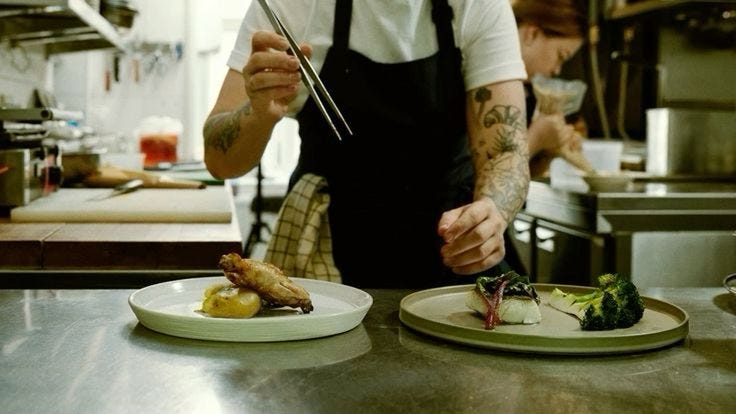
Taste isn’t what they cook; it’s how they decide. This tension - between memory and surprise - exists on a spectrum. Every decision lives somewhere on that line.

On the left: obsolete. So familiar it’s invisible. Pure memory.
On the right: obscure. So novel it’s incomprehensible. Pure surprise.
The big chunk in the middle: the norm. Where most work lives and dies.
You know this fight. Creatives pull right - chasing the unseen. Finance pull left - chasing spreadsheets. Every corporate call becomes the same philosophical war dressed up as pragmatism.
Here’s the thing: Value doesn’t live in the middle. It lives in that narrow band just off-center. Close enough to what people understand, far enough to change how they see.
Most companies die in the middle because fear looks like prudence. Most artists die on the edges because they mistake being difficult for being sophisticated. The ones who matter? They find that five-degree angle where comfort meets discomfort. Where people don’t quite know why they’re paying attention, but they are.
There’s the sweet spot: Familiar enough to land. Novel enough to surprise.
This is the target.
And you can see this everywhere:
Look at Rosalía’s recent album LUX.
After Motomami redefined pop, Rosalía could’ve cashed the check and made Motomami 2.
She didn’t. She went baroque.
Sacred music. Latin chants. London Symphony Orchestra. 13 languages.
The result? Complex. Accessible. Genius. 2
She found the edge - novel enough to surprise, grounded enough to land.
Rosalía’s genius wasn’t just artistic - it was directional.
She knew how to steer culture without repeating herself.
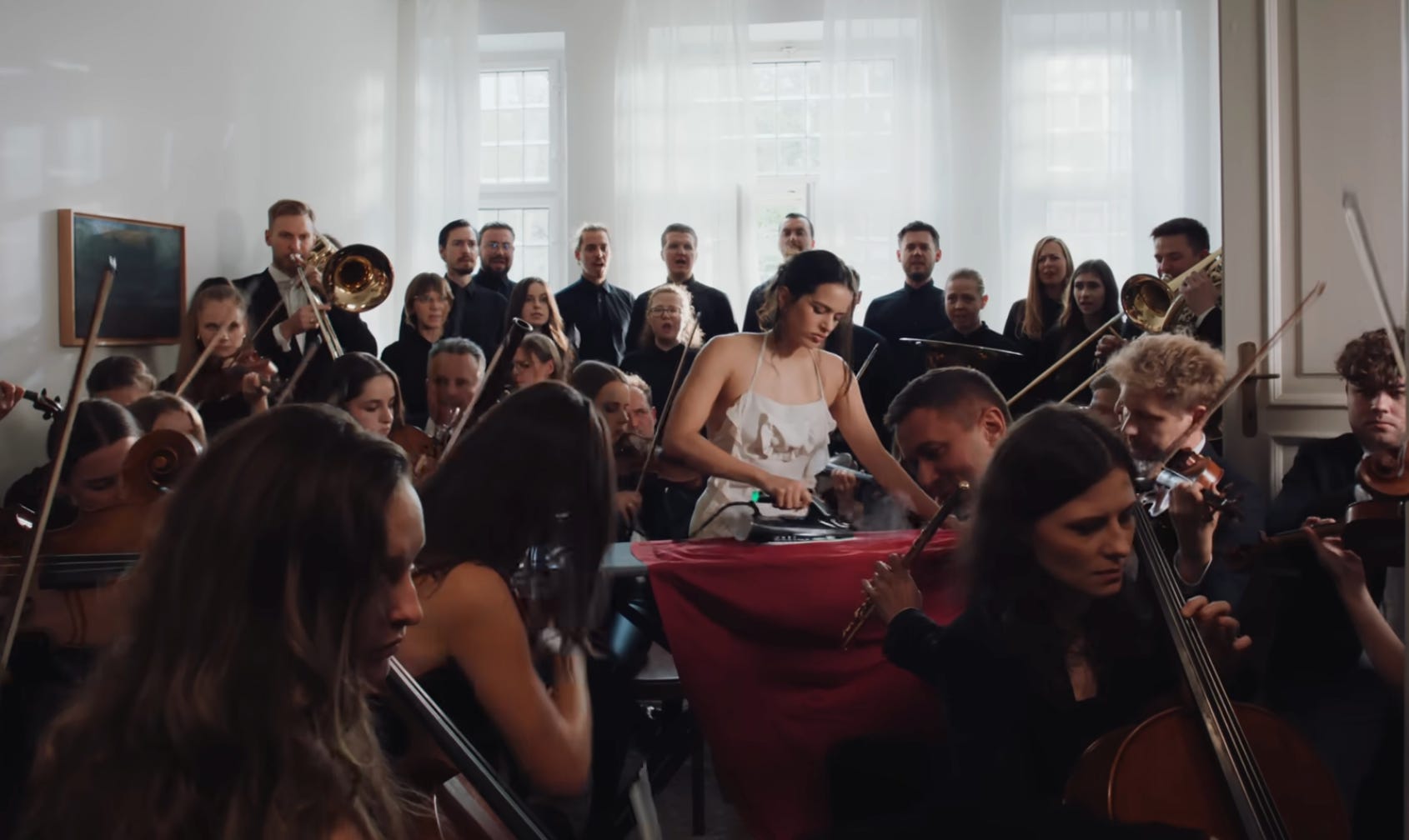
Or take MUBI.
While Netflix drowns you in options, MUBI offers intention. They realized that in the age of algorithms, less isn’t a limitation - it’s a luxury.
There’s no mainstream anymore. Just thousands of parallel ones. And in a fragmented world, owning the relationship is worth more than owning the content.
MUBI isn’t selling movies.
They’re selling taste.
IYKYK as a business model.
Sequoia just valued that at a billion dollars. 3
And neuroscience shows why this works:
Your brain is hardwired for exactly this tension. Studies show we constantly process sensory data, creating new versions of the world. An evolutionary tweak that lets us absorb reality and generate what-if scenarios.
Our brain craves a specific balance: Novelty - but not chaos. Familiarity - but not loops. 4
We don’t want to live in a infinite loop, but we also don’t want to be surprised all the time. Too much predictability and we tune out. Too much surprise and we become disoriented.
This isn’t philosophy. It’s biology.
That’s why first cars had to look like horse carriages. Why iPhone needed skeuomorphism. Why every transformative technology borrows the clothes of the old until our brains are ready to see it naked. We’re neurologically wired to need bridges between old and new.
The brands that win don’t fight this wiring. They utilize it.
So what happens when AI enters the kitchen?
Three key observations:
First the good news: Time favors the brave.
The spectrum has physics to it. Everything drifts left.
What surprises today becomes memory tomorrow. What feels novel now gets normalized next year. Obscure becomes norm. Norm becomes obsolete. The pace varies, but the direction never changes.
Obscure trumps norm. Margiela was unwearable until it wasn’t. Brutalism was dead until it wasn’t. The question isn’t if, it’s when.

But here’s what’s new: AI accelerates this drift. What used to take a decade now takes six months. The algorithm spots patterns, scales them, exhausts them. Fashion cycles that took years now take seasons. Trends that evolved over decades now flip weekly.
Everything converges toward the same optimized middle. AI makes everything look like everything else, just faster. 5
Yes, the window shrinks but here’s the paradox: The more everything becomes the same, the more the edge matters. The machine homogenizes everything so efficiently that any deviation becomes signal. The rarer originality becomes, the higher its premium. 6
Second, stay alert: AI can’t taste - it can only measure
A chef tastes, adjusts, breaks their own rules mid-service when something feels off. They start with instinct and edit toward understanding.

An algorithm measures engagement, optimizes patterns, A/B tests until conversion peaks. It starts with data and iterates toward more data.

AI works backward from proof. Humans work forward from possibility. One needs evidence to move. The other needs courage. 7
Taste is judgment without complete information. It’s knowing when to break the pattern you just established. It’s feeling that something is about to feel tired before the numbers show it. And it’s the last thing AI can’t do.
Humans own the right side of the spectrum - the obscure, the instinctive, the “what if.” AI is trapped on the left, optimizing what already exists. That’s not a bug in the system. That’s the system. 8
Last but critical: Input equals Output
If your feed is fast food, your judgment will be too.
AI trains on the average. It optimizes for what already exists. If you’re consuming the same inputs as everyone else - the same feeds, the same references, the same patterns - you’re feeding your brain the exact dataset AI was built to dominate.
You can’t out-pattern a pattern machine with pattern thinking.
Your edge isn’t working harder on familiar ground. It’s standing on different ground entirely. The chef who’s only tasted one cuisine can’t recognize greatness. The designer who’s only seen this decade’s trends can’t spot what’s next. Range sharpens judgment. Range creates taste. 9
Even if your goal is to make fast food, it’ll taste better if you’ve experienced the rarest ingredients along the way.
Taste isn’t optional anymore. If your inputs look like everyone else’s, your work is one prompt away from becoming obsolete.
So go out. Seek the obscure. Go niche. Fill your mind with things algorithms don’t index yet.
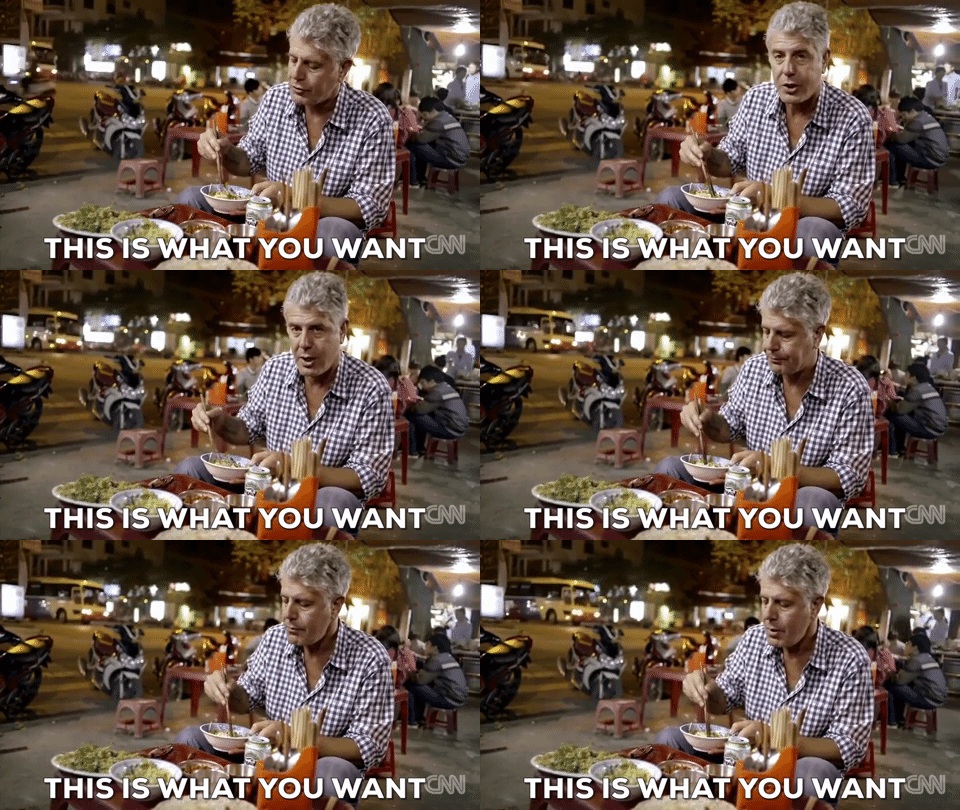
Bourdain said it best:
“If I’m an advocate for anything, it’s to move… walk in someone else’s shoes or at least eat their food, it’s a plus for everybody. Open your mind, get up off the couch, move.” 10
Retrieved from instagram.com/27_bucks
Rosalía (2025). LUX [Album]. Columbia Records. Released November 7, 2025. Recorded with the London Symphony Orchestra conducted by Daníel Bjarnason. Metacritic score of 97/100 indicating “universal acclaim.” The Guardian’s Alexis Petridis described it as “a demanding, distinctive clash of classical and chaos that couldn’t be by anyone else.” Retrieved from metacritic.com and theguardian.com/music/2025/nov/07/rosalia-lux-review
Summit Partners. (2025). MUBI Raises $100 Million in Growth Financing Led by Sequoia Capital. Sequoia Capital leads investment valuing indie streaming platform at $1 billion. Retrieved from summitpartners.com/news/mubi-raises-100-million-in-growth-financing-led-by-sequoia-capital
Eagleman, D., & Brandt, A. (2017). The Runaway Species: How Human Creativity Remakes the World. New York: Catapult. On neuroplasticity and the brain’s balance between novelty and familiarity: “Brains seek a balance between exploiting the knowledge we’ve earned and exploring new surprises. Too much predictability and we tune out; too much surprise and we become disoriented.” Retrieved from bigthink.com/neuropsych/david-eagleman-hits-and-misses-how-neuroscience-can-boost-your-creativity/
Doshi, A. R., & Hauser, O. (2024). Generative AI enhances individual creativity but reduces the collective diversity of novel content. Science Advances. On the homogenization paradox: “These results point to an increase in individual creativity at the risk of losing collective novelty.” Retrieved from science.org/doi/10.1126/sciadv.adn5290
Bourdieu, P. (1986). The Forms of Capital. On scarcity creating distinction: “Any given cultural competence derives a scarcity value from its position in the distribution of cultural capital and yields profits of distinction for its owner.” Retrieved from marxists.org/reference/subject/philosophy/works/fr/bourdieu-forms-capital.htm
Ding, A. W., & Li, S. (2025). Generative AI lacks the human creativity to achieve scientific discovery from scratch. Scientific Reports. On AI’s limitations: “Current GenAI is good only at discovery tasks involving either a known representation of the domain knowledge or access to the human scientists’ knowledge space.” Retrieved from nature.com/articles/s41598-025-93794-9
Zhang et al. (2025). Artificial Intelligence Reshapes Creativity: A Multidimensional Evaluation. PsyCh Journal. On AI’s creative limitations: “AI’s creativity remains programmatic, primarily limited to incremental and combinatorial creativity.” Retrieved from onlinelibrary.wiley.com/doi/full/10.1002/pchj.70042
Hume, D. (1757). Of the Standard of Taste. On taste as delicacy of perception developed through practice and range of exposure: “Strong sense, united to delicate sentiment, improved by practice, perfected by comparison, and cleared of all prejudice.” Retrieved from home.csulb.edu/~jvancamp/361r15.html
Bourdain, A. Quote on movement and cultural experience: “If I’m an advocate for anything, it’s to move. As far as you can, as much as you can. Across the ocean, or simply across the river. The extent to which you can walk in someone else’s shoes or at least eat their food, it’s a plus for everybody. Open your mind, get up off the couch, move.” From Medium Raw: A Bloody Valentine to the World of Food and the People Who Cook and various interviews.
I wish it was a book, and I could read a little lifetime in it.