

005 - After the Surface
The most creative work in modern history was made by people who'd been told their profession was finished. We are here again.

For Future Reference is about seeing what matters before the market has language for it. Culture, creativity, brands, technology, taste, timing. I’m Manuel Steiner, founder of 27BUCKS, an Office for Brand Architecture, with work across Apple, Mercedes-Benz, and Billie Eilish.
A student asked me last month if she should quit design school. She’d done the math. Three years to learn a craft a machine could already do in three hours. She wanted to know if I’d be honest with her about what she was actually paying for with her twenties.
I told her about the camera.
The Day Painting Lost Its Excuse
In 1839 a chemist in Paris showed an audience a small metal plate. On it was a perfect image of a Parisian street, captured by light alone. The crowd applauded. Within a few years, large parts of professional painters were functionally obsolete.
This was a bigger deal than most people understand.
Painting was infrastructure. If anyone won a battle, someone had to paint it. If your Grandchildren wanted to know your face, someone had to paint it. If anyone wanted to see gods, kings, myths, landscapes, cities - someone had to paint them. Painting was how civilisations remembered themselves. It was the technology for making the world visible.
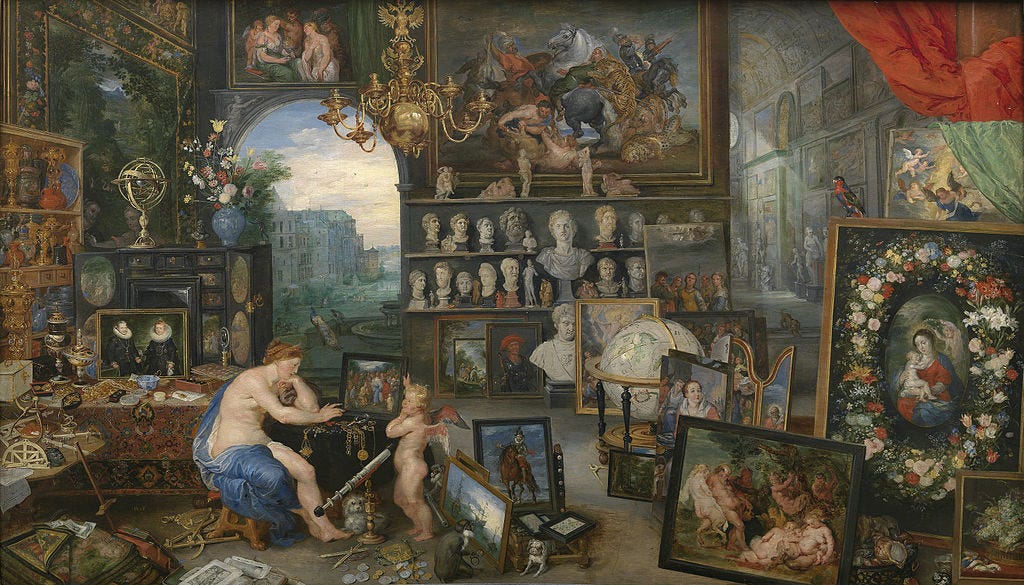
Portraiture alone accounted for roughly 45% of all works at the Royal Academy. Half of the collection at Britain's most prestigious art institution are headshots.1
For centuries, value meant fidelity. Skin. Light. Perspective. Cloth. Surface. Can you copy the world better than the person next to you?
Then the camera arrived. Faster. Cheaper. More accurate than any human hand. Studios closed. The portrait business collapsed. Photography didn't just compete with painting. It claimed painting's most visible function at maybe one percent of the cost.
So obviously painting died.
Except it didn’t.
Even stranger, it started it’s most creative run.
Impressionism. Post-Impressionism. Expressionism. Fauvism. Cubism. Abstraction. Every major movement in modern art happened after the camera showed up.
How?
That's the question. Because the same thing is happening right now to creative work, and the conversation about it is mostly garbage. Either AI is going to make everyone a creative god ("democratization!") or AI is going to make every knowledge worker unemployed ("the death of the profession!"). Both takes are wrong. The painters can show us why.
Monet did not out-render the camera. He changed the perspective: from object to time. Cézanne changed it from view to structure. Van Gogh changed it from likeness to emotional truth. Munch changed it from scene to psyche. Kandinsky changed it from depiction to pure form.
They stopped reproducing what we see. They started making us see.
Again: They stopped reproducing what we see. They started making us see.2
Each one made a bet on what was more real than optical accuracy: time, structure, feeling, psychology, spirit.
The best part: It's a pattern. The printing press. The phonograph. The camera. Every time a new technology eats the surface, everything else becomes more valuable.3
When reproduction is free, depth becomes rare.
My student isn’t wrong to be afraid.
The World Economic Forum said graphic design is among the most at-risk jobs in this new era.4 Yale researchers have argued that generative AI will displace large categories of commercial creative work.5 Midjourney does the logo. Claude does the copy. v0 does the layout. ElevenLabs does the voiceover. Suno does the soundtrack. Runway does the video.
The reproductive part of what she’s learning is becoming nearly worthless. But the panic is missing the real story.
The painters didn’t lose painting. They lost one part of painting. The camera took likeness and reproduction. The rich man’s chin. The wedding portrait. The family record. The proof that someone had been there, looked like this, owned that, married them.
Art historian Hans Rooseboom looked through the records and found exactly one documented case of a painter directly displaced by photography. One.
What he found instead was relief.6
Before photography, reproduction and meaning were bundled together.
The camera split the bundle.
It seperated reproduction from meaning. And by doing that, it exposed what painting had been carrying underneath all along. It made the depth impossible to ignore.
The camera did painting a favor and liberated it from the surface.7 Without the camera there would be no Kollwitz, no Picasso, no Richter.
Same does AI.
It will take over the reproductive part: options, polish, layouts, copy, research, decks, assets, strategy-shaped language. Good. That layer was never the whole job.
And uncovers the work underneath: judgment, diagnosis, timing, taste, context, structure. The ability to know what matters, what is broken, why now, how far, for whom, and whether it holds.
For years, creative work has charged for the visible thing and hidden the judgment inside it for free. We priced the deck. We hid the thinking. We sold the asset. We buried the seeing. The inability of an entire industry to articulate why its work is worth what it costs is the reason creative pricing has been flat for twenty years in real terms. AI isn’t creating that crisis. AI is just exposing it faster.8
The deck was never the value. The design was never the value. The asset was never the value. The value was the seeing that made the thing necessary.
Once the bundle breaks, the question gets much clearer:
What part of your work was reproduction?
What part was judgment all along?
If the surface is going, what is the rest of it?
The limits of my language are the limits of my world.
This is where most so called thought leaders get vague. They wave at “human creativity.” They invoke “empathy.” They say “soul.” Or quote Walter Benjamin’s concept of “aura.”9 They post about being more human in an inhuman age.
All fair, but not enough.
The painters didn’t survive by talking about aura. Monet pointed at time. Cézanne pointed at structure. Van Gogh pointed at emotional truth. Munch pointed at psychology. Kandinsky pointed at pure form. Each one could name it. Each one could defend it. Each one could build a practice around it.
We need the same specificity.
If we can’t name what we see, we can’t teach it.
We can’t scope it. We can’t price it. The client can’t value it.
That’s why I started this here: to give language to what I kept seeing in the work. A vocabulary for the part of creative work that was always there, but hidden inside the making.
I see four lenses.
Time asks when something matters. Gravity asks why it pulls. Taste asks where it sits in culture. Scope asks whether it holds up in reality.
Together, they form a cycle of creative judgment in a post-AI world.
The Four Lenses of Post-AI Creativity:
TIME
A brand, idea, or piece of work is never neutral in time. It carries a past, enters a present, and makes a claim about the future. Time is the ability to feel whether something is too early, too late, right on time, or borrowing from a past it has not earned. Van Gogh and Cézanne remind us that value is not always legible in the moment. Time converts memory into momentum.

GRAVITY
A brand, idea, or piece of work does not move people because it looks good. It moves people because it answers a deeper need: progress, control, belonging, or belief. Gravity is the ability to see which force matters, which force is missing, and which force the work must organize around. Munch understood this. The scene was never the point. The pull came from the rupture underneath, the anxiety people could feel before they could explain it. Gravity converts need into pull.

TASTE
A brand, idea, or piece of work does not become valuable by being familiar or new. It becomes valuable by finding the right tension between both. Too familiar, and it disappears. Too new, and it becomes unreadable. Taste is the ability to feel that narrow band where comfort meets discomfort, where something lands but still changes how people see. Monet found that edge. A haystack was familiar enough to enter, strange enough to become time, light, and atmosphere. Taste converts tension into attention.

SCOPE
A brand, idea, or piece of work exists at two scales: the telescope and the microscope. The telescope is what it claims from far away: vision, identity, meaning, ambition. The microscope is what people find up close: decisions, trade-offs, standards, behaviour. If the two don’t match, trust breaks. Kandinsky’s strength was coherence: theory, colour, music, spirituality, form, teaching, all pointing toward the same worldview. Scope converts promise into proof.

Not software skills. Seeing skills. Closer to history, psychology, criticism, and architecture than to production. They cannot be prompted, because they require judgment before output. But they can be learned. Through study, attention, range, practice, and contact with reality.
Together, they are the work before the work. The part AI cannot do for you.
AI is, by its very nature, extremely good at prediction.
Creativity is, by its very nature, the thing data couldn’t have predicted.10
That’s why these skills matter now. Time gives direction. Gravity gives pull. Taste gives edge. Scope gives trust.
The Four Lenses of Post-AI Creativity.
Here’s what I told my student.
Do not quit.
But drop the part of your education that AI is going to eat. Drop the rendering. Drop the retouching. Drop the reproduction. None of that is where your value will sit in five years.
Study history, not trends, so you understand what came before, what something reacts to, and what futures it might open. Study people, not audiences, so you can see the needs beneath the brief. Widen your inputs beyond design, because taste comes from range, not repetition. Learn how systems hold together, so the big idea survives the small details and the promise matches the behaviour.
The students who make that bet will be worth more in five years than the generations before them. The ones who don’t will compete with a machine that doesn’t sleep, bill, or doubt.
The goal of education is to make a person conscious of their creative power. Not scared of new facts. Not dependent on formulas.11
The portrait painters disappeared. The ones who went deeper changed art forever.
They stopped reproducing what we see. They started making us see.
Hatt, Michael & Klonk, Charlotte, eds. (2018). Royal Academy Chronicle 1769–2018, “1812: Gender and the ‘Present State of … Public Taste’” by Cassandra Albinson. On the dominance of portraiture in early nineteenth-century Royal Academy exhibitions: “from 1788–1829, according to one recent estimate, portraits comprised about 45 per cent of all exhibits.” Retrieved from chronicle250.com/1812
Klee, Paul (1920). “Schöpferische Konfession” (Creative Credo), Section I, in Tribüne der Kunst und der Zeit, Band XIII, edited by Kasimir Edschmid. Berlin: Reiß. Original German: “Kunst gibt nicht das Sichtbare wieder, sondern macht sichtbar.” English translation: “Art does not reproduce the visible; rather, it makes visible.” Reprinted in Paul Klee: The Inward Vision (New York: Harry N. Abrams, 1958).
Eisenstein, Elizabeth L. (1979). The Printing Press as an Agent of Change: Communications and Cultural Transformations in Early Modern Europe. Cambridge: Cambridge University Press. The canonical academic account of how the printing press, by claiming the scribe’s reproductive function, enabled the Reformation, the scientific revolution, the novel, and the modern public sphere. Eisenstein’s central argument: the press did not simply distribute existing knowledge faster — it transformed the nature of intellectual production itself.
World Economic Forum (2025). The Future of Jobs Report 2025, January 2025. Geneva: World Economic Forum. Based on a survey of 1,000 employers representing more than 14 million workers across 22 industry clusters and 55 economies. The report ranks graphic design as the 11th fastest-declining job category by 2030, attributing the shift to “generative AI rapidly reshap[ing] the labour market.” Retrieved from weforum.org/publications/the-future-of-jobs-report-2025
Tan, Sophie & McNamara, Megan (2023). “What AI art means for society, according to Yale experts,” Yale Daily News, 23 January 2023. Featuring perspectives from Yale researchers including Amin Ebrahimi Afrouzi (Yale Law School’s Information Society Project), who predicted that AI art will displace “menial” forms of creative work currently “relegated to stock photos.” Retrieved from yaledailynews.com/blog/2023/01/23/what-ai-art-means-for-society-according-to-yale-experts
Rooseboom, Hans (2006). What's Wrong with Daguerre? Reconsidering Old and New Views on the Invention of Photography. Amsterdam: Rijksmuseum / Nescio. On the question of whether photography displaced nineteenth-century painters: Rooseboom found only one documented case of an artist directly displaced by photography — an 1874 reference to a recently deceased portrait painter — and instead found multiple reports of an artistic revival around the time photography took hold, with painters welcoming the camera as relief from commercial portrait work.
Zervos, Christian (1935). “Conversation avec Picasso,” Cahiers d’Art, Vol. X, No. 7–10, pp. 173–178. English translation in Alfred H. Barr Jr., Picasso: Fifty Years of His Art (New York: Museum of Modern Art, 1946). Picasso on what photography did for painting: “Photography has arrived at the point where it is capable of liberating painting from all literature, from the anecdote, and even from the subject.”
The structural decline of agency and creative compensation is documented most thoroughly by Michael Farmer in Madison Avenue Manslaughter (LID Publishing, 2015) and Madison Avenue Makeover (2023). TrinityP3 reports that agency salaries are lower in real terms than ten years ago, and that fees have steadily declined for three decades.
Benjamin, Walter (1936). “Das Kunstwerk im Zeitalter seiner technischen Reproduzierbarkeit” (”The Work of Art in the Age of Mechanical Reproduction”), originally published in Zeitschrift für Sozialforschung, Vol. 5, No. 1, in French translation by Pierre Klossowski. On the loss of the singular presence of the artwork under mechanical reproduction: “That which withers in the age of mechanical reproduction is the aura of the work of art.” English translation by Harry Zohn in Illuminations, ed. Hannah Arendt (New York: Schocken Books, 1969). Retrieved from web.mit.edu/allanmc/www/benjamin.pdf
Zelnick, Strauss (2026). Interview with David Senra, "Grand Theft Auto GTA6 & A $45B Entertainment Empire," 17 May 2026 (timestamp 1:34:26). On AI and creative work: "Asset creation is a necessary but insufficient condition for hit creation. All hits are by their very nature unexpected. Things that are data-driven in their entirety can't be unexpected." Retrieved from youtu.be/1ZgUcrR0K7I?t=5666
Moholy-Nagy, László (1947). Vision in Motion. Chicago: Paul Theobald. On the goal of design education at the New Bauhaus / Institute of Design, Chicago: “We wish to make [the student] conscious of his own creative power, not afraid of new facts, working independently of recipes.” Retrieved from archive.org/details/visioninmotion00moho
I always thought the way I worked was wrong because I focus a lot on strategy and concept and refuse to create without meaning, but this gave me new motivation and a new perspective on my own expertise. Thank you for that! Very valuable work
I like the four lenses